Keep the book
Before you remind your son again
He isn't lazy.
He's unemployed.
Nothing in your house waits for him, so he waits for you. Self-Reliance, Dorothy Canfield Fisher's 1916 book, shows how to hand him a standing job of his own.
 1916
- Why “can you just…” starts a fight and a standing job doesn't.
- What to hand over at five, at ten and at fourteen.
- No sticker chart, no app, no third reminder. One standing job.
60 days, money back, keep the book. One-time purchase. No subscription.
- 60 days, money back
- Two guides included
- Paperback printed in USA
7:40 a.m.
The bus comes at 7:52.
He is on the stairs. One shoe on.
You have said “shoes” three times. “Backpack” twice.
You are in the kitchen, packing his lunch. Since 6:30 you have fed the dog he begged for. Signed the form. Found the library book. Pulled his jersey out of the dryer.
Five jobs. Every one of them yours.
Now count his.
He got up because you woke him. He ate what you put down. In twelve minutes he will walk out wearing what you found and carrying what you packed.
He is a bright, healthy eleven-year-old, and in his own home he does not have one job.
So he does what any of us would do with no job and every need met.
He waits to be told.
The cause is on page 3
Lazy is a verdict on the child. Unemployed is a fact about the house, and a house can be changed.
The promise: the jobs are his, and he does them because they are his. Not because you said it three times.
A fantasy? A mother wrote it down in 1916, and she did not call it easy.
You were sold a listening problem. It is not his attitude. It is not your tone. It is a work problem. Her book names the thing that took his work away.
Her sentence is below, on the real page. The highlighter is ours. Now look around your kitchen.
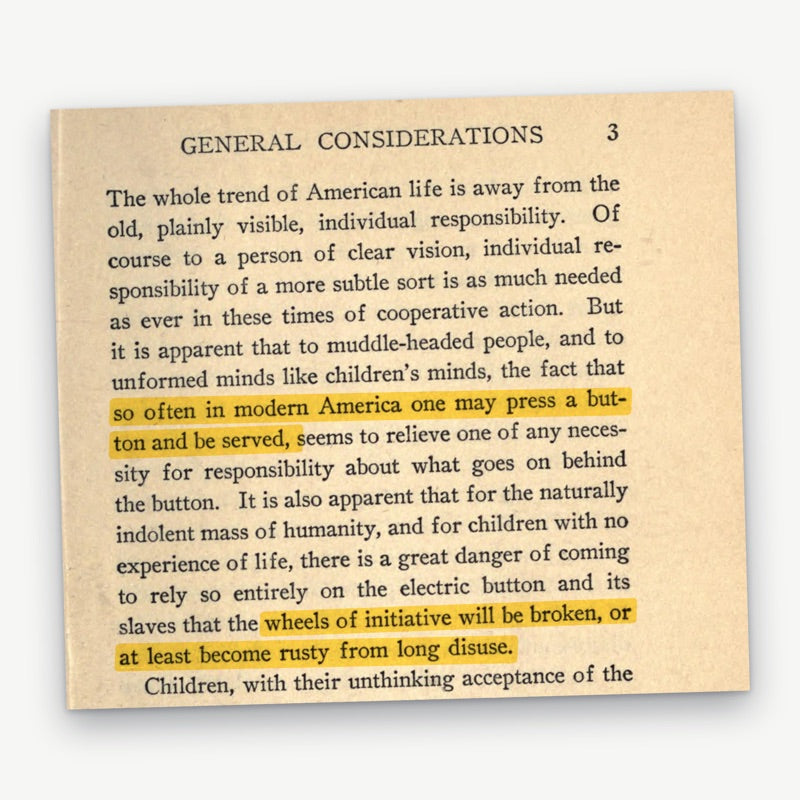
Call it the Button. It washes the dishes, dries the jersey and brings dinner to the door. It has been in your house longer than he has.
The second yellow line is the danger she named for a child: initiative “rusty from long disuse.”
The world has no button marked Mom.
By the author of Understood Betsy
The mother who saw where the work went
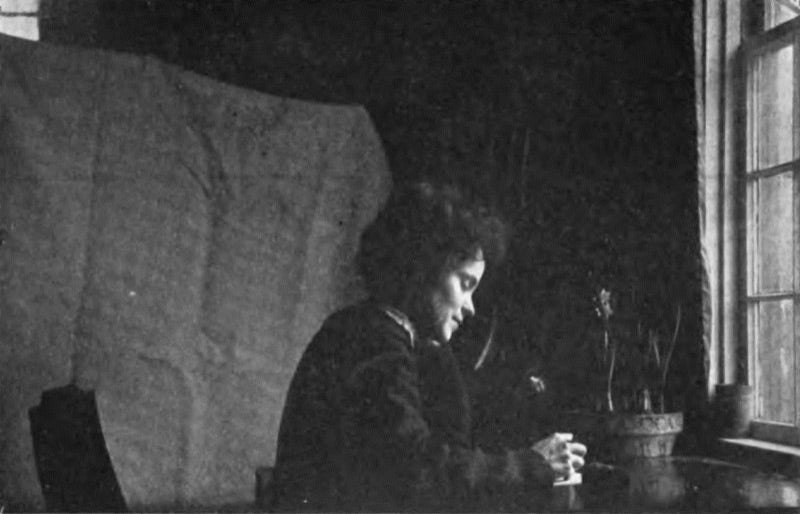
This is Dorothy Canfield Fisher, in a photograph printed in 1912. She wrote the book at home in Vermont, the mother of a girl of six and a boy of two when it came out.
It was the last of four books on bringing up children that she published between 1912 and 1916. The first, A Montessori Mother, was one of the books that introduced the Montessori method to American parents.
At home, she wrote, “We do things for ourselves” (p. 160). Then a night train carried her “five hundred miles and about a hundred years from home” (p. 161).
People pushed a button to stop the streetcar. Bread came to the kitchen doors by cart: the women, she wrote, had “pressed a button and bread ensued” (p. 162).
And then: “But at once I asked myself uneasily, how about the children?” (p. 164)
I am a parent myself, and no educational expert
Notices of her book, 1916-1917
The papers called it the push-button age
Mrs. Fisher finds the present ‘push-button’ age unwholesome for children.
in this push-the-button age children lack the old occasions to do for themselves
labour-saving devices of present-day society, which threaten to create a helpless and luxury-loving generation.
the only practical suggestions yet made for teaching self-help to steam-heated, butler-fed, duplex-apartment kids.
Yours have no butler. They have you.
That was 1916. The Button was only getting started.
Three pages you will want tonight
- Doing it for him is less trouble, right? Wrong. She wrote down the exact sentence a mother uses to excuse it, and called it a “natural instinct.”p. 133
- END THE BEDTIME WRANGLE. Families she knew set the hour in “family conclave,” the child included, then made getting to bed part of his own day's work.p. 46
- What never to do when he begs for extra money. She says it “vitiates the whole system,” and a tired parent does it “to gain a tranquil half-hour after dinner.”p. 132
60 days, money back, keep the book. One-time purchase. No subscription.
Six honest reasons to close this page
It reads like 1916, because it is. Nobody rewrote it into a course. You can check every line.
Four of the seventeen chapters are about schools. About 38% of the pages. The page that explains your son is in one of them.
The first week gets harder. A button does the job at once, and right. A child does it slowly, and badly. Better, she says, that a small child “take an hour to put on his own shoes” than that his mother do it “in thirty seconds” (p. 18).
She does not promise a quieter house. Initiative, once awake, is “not conducive to the quiet stagnation in the home” (p. 5). A capable boy is louder than a boy on a couch. Quiet is what the Button sells.
She is sharp with mothers, herself first: “all of us besotted mothers” (p. 21). That is how you know a mother wrote it.
And it is not for every parent. Not for the one who wants to get through childhood “with as little trouble as possible” (p. 5). That parent already has the Button.
A whole day without one job
It was never about the bowl.
It is that you stood in your own kitchen tonight and felt like the staff.
Unpaid, unthanked, on call from 6:30 to 9:40. When you miss one thing, the hungry dog is somehow your fault. And when you finally raise your voice, he looks up, hurt, and asks why you are always so angry.
You go to bed sick of your own voice.
The larger bill is his
Every day this house trains him in one skill: waiting to be told.
One day he takes it to an employer who says a thing once.
His first real job should not be the first job he has ever had.
You do not spare him a job by doing it for him. You move it to a year when you are not there.
60 days, money back, keep the book. One-time purchase. No subscription.
Nobody fired him. The work left.

You asked nicely. You counted to three. That was not weak mothering, and it was not a flaw in your boy. You were trying to manage an unemployed child, and nothing manages unemployment. Only work ends it.
On page 179, in one of those school chapters, she watches schoolchildren haul sand in wheelbarrows and hears parents all over the country: “We can't get those children to do a single bit of work at home.” Her answer:
in a modern home practically no interesting, constructive work suitable for a child is left to do.
The word unemployed is ours. The diagnosis is hers. The Button did not make him lazy. It took his work. What it left him, on the same page: “a few rags and tatters of meaningless drudgery.”
Of one boy from a house “abundantly furnished with buttons-to-be-pressed,” she wrote in the same chapter: “It was not his parents' fault. Never have parents taken such anxious thought about their children's best interests as now.” (p. 170)
It is not yours. But it is your shift, and a shift can end.
Page 28, in her words
What the Button did to a good housekeeper
The avowed aim of every good housekeeper is to run her house with no show of the effort it costs her, so smoothly that the machinery is both inaudible and invisible.
You achieved the aim. Your house runs so well that he thinks it runs itself. For him, a bed made “by either a competent mama or a well-trained servant” comes to the same thing (p. 28).
In 1916 the button rang for a servant. In your house it rings for you.
Why he never says thank you
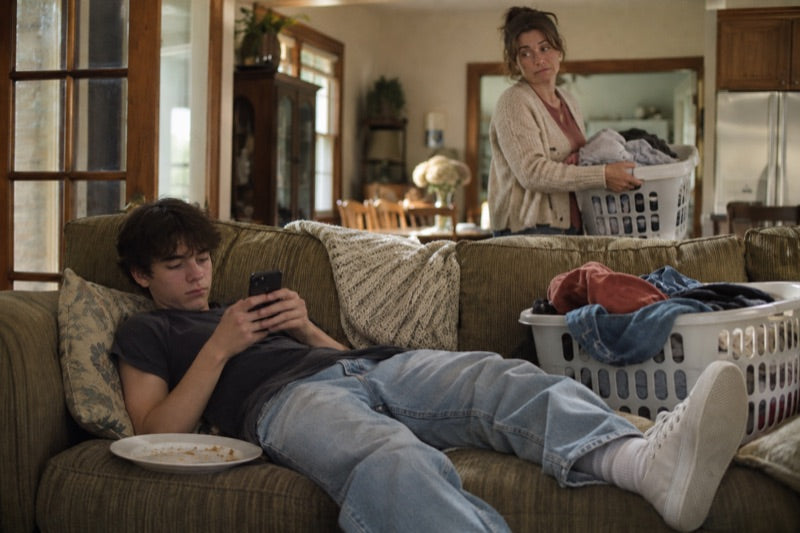
He isn't ungrateful. A guest does not thank the hotel for hot water. He never sees it arrive.
That is his side of page 28: “all the consequences of his acts are noiselessly and competently shouldered by other people.” You are the other people.
A child with no work still practices something all day. He practices being served.
She called that life “the servitude of being waited upon” (p. 20). In anyone, it builds “habits of inertia and moral flabbiness” (p. 4).
Two people are caught in this. Only one of them can end it.
60 days, money back, keep the book. One-time purchase. No subscription.
The instinct is asleep, not gone

The lazy boy in her book is in college, and only “apparently invincibly lazy” (p. 41). What changes him is not a lecture. It is the day “the responsibility for his own life is laid upon him.”
Such a miracle always takes place, in any human being of any age with the bestowal of the sacred, the divine gift of responsibility.
She named what waits in him: the Robinson Crusoe instinct, the urge to manage for himself. “In a child it is almost always already present, already longing for exercise” (p. 70). Asleep is our word. Asleep is not gone. He taught himself every game he owns. Nobody reminded him.
Ten seconds, in your own kitchen
The one-job test
Name one thing in your house that does not get done unless he does it.
Not something he does when you say so. Something that is his, that would sit undone if he walked away from it, and that someone would notice.
Take your time.
If nothing comes, you have your answer, and it is good news. You do not have a lazy child. You have a capable child with nothing to do, in a house that has been running perfectly without him.
That can be changed tonight, by the person reading this.
60 days, money back, keep the book. One-time purchase. No subscription.
Page 33
Why a sudden errand becomes a fight
Instead of a job, we give him errands. She had a verb for it.
children, even little children, are much like the rest of us and infinitely prefer to have some regular definite task, reasonably related to their own life, than to be pounced upon spasmodically at any hour which suits an adult
You feel on call all day. Her next sentence says he is too: “at the beck and call of every adult who wants spectacles fetched.”
You would quit a job like that. He cannot quit, so he says “In a minute.”
A reminder is the proof the job is still yours. You are not reminding him of his work. You are doing the remembering, which is the work.
Stop asking for help. Start handing over work.
One afternoon, lived twice
- 4:05 “Can you just take your shoes up?”
- 4:20 “Can you just let the dog out?”
- 4:50 “Can you just bring me the basket?”
- 5:20 “Can you just take these up?”
- 6:15 “The trash. Now. I mean it.”
- Five negotiations. Tomorrow, five more.
- The dog is his. Morning and night.
- Agreed on Sunday, sitting down.
- No dog? His bed, his laundry bag, the porch.
- At 4:20 the dog went out. Nobody said a word.
Six marks of real work
Our names. Her lines.
- Standingp. 8
The same job, every day.
“regular responsibility for any recurring task”
- Hisp. 34
His bed, his laundry, his dog.
“he sees the justice of the demand made on him”
- Agreedp. 34
Settled once, sitting down.
“a leisurely, friendly discussion with his parents”
- Requiredp. 33
Not a favor. Not for sale.
“required of him as a matter of course”
- Finishedp. 33
Then he is done. Unplanned work is still shared.
“when he has done his day's work, his time is, for the most part, his own”
- Growingp. 35
Light at first, harder every year.
“a more difficult and hence more interesting share of the household activities”
And one for you: then leave the room. A job that needs you standing over it is still yours.
60 days, money back, keep the book. One-time purchase. No subscription.
A chore is invented. A job is needed.
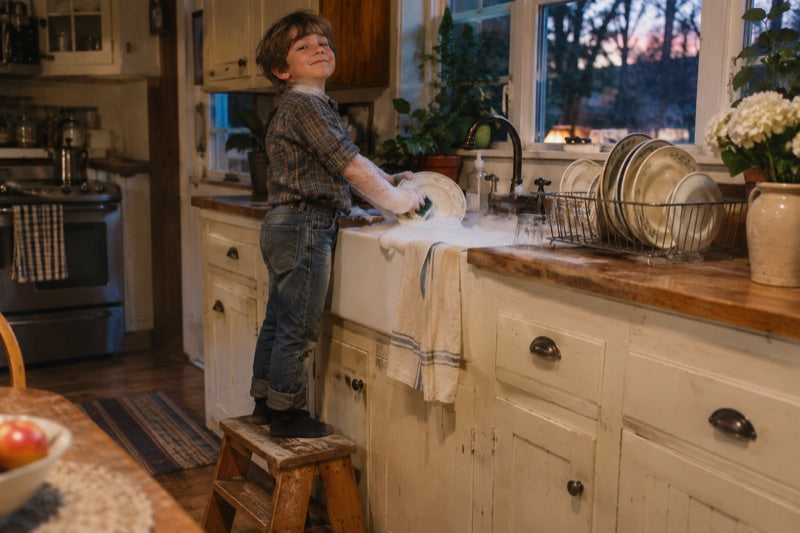
You are thinking: chores. Tried them. Fair. But she is harder on chores than you are. Her phrase for the kind a mother invents so a boy has something to do: “artificially manufactured with despairing ingenuity” (p. 151). A child can smell a made-up job.
Her first jobs are plain housework: he can “make his own bed” (p. 34). Others are not brooms at all: “the monthly payment of certain of the family bills” (p. 8).
A standing job is something the house needs, that is his.
What you tried kept you the engine
The sticker chart. It works, for a while. You are inspector and paymaster.
The app reminds him. That is still a reminder. You changed the ringtone.
The calm voice named every feeling he has about the trash. His feelings got words. He never got a job. It is still your trash.
Taking the tablet works tonight. Tomorrow you are the warden, and wardens keep longer hours than mothers.
Doing it yourself. It is how you got the job.
Run each through one sentence of hers.
Nothing is enough which depends upon our presence, upon the presence of any adult.
She has a chart too (pp. 49-50), a weekly treat (p. 46) and paid extra jobs (pp. 36-37). The difference: hers is prepared with the child and “authorized by himself.”
The Button took his work. The people who sold you the chart and the app kept you the engine. And you got the blame.
From chapters I and IV
The 1916 standard, age by age
Read down. Stop at the first line he does not do without being told.
- At fivep. 44
“can begin to be held responsible for the cleanliness of his own clothes”
- At sixp. 45
“dress himself, brush his own teeth and wash his own face”
- At ten or twelvepp. 52-53
“ordering his own food, asking for the bill, verifying the items and paying for the total”
- At fourteenp. 51
Route and budget, under “their parents' advice and veto.”
“plan all the family trips”
- A boy of sixteenp. 6
Five things he “needs to be taught.” The fifth:
“how to make an appointment with the dentist”
That line is not his grade. It is your starting line.
If you ever thought he could do more, you were not harsh. You were right.
She never printed these as one chart. The Standing Jobs Chart does.
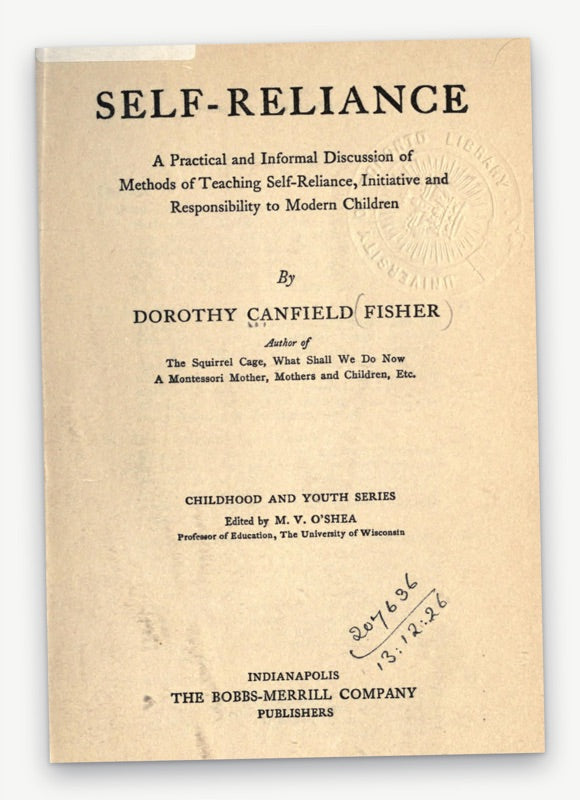
Where every quoted page comes from
The 1916 book, complete
Every page quoted above comes from one book. This is its title page. Read the subtitle to its last three words: “to Modern Children.”
Our edition is all of her text: 17 chapters, complete and unabridged. Newly typeset and proofread, to read on your phone or leave on the kitchen table.
The prose is 1916. The children are yours.
60 days, money back, keep the book. One-time purchase. No subscription.
Inside, chapter III
She counts out her own money

What is paid and what never is: the daily job is never paid. It is his share of the house. Extra work has a price list: “Washing three windows is worth a nickel” (p. 37).
And the rule that ends the begging: “If he wants it enough to work three or four days to get it, he can have it. If not, he can go without.” (p. 37)
Jobs you stop doing
The reminder service and the housekeeper
- “Where are my rubbers?” Rainy morning, nobody can find them. He is careless, right? Wrong. She blames one missing “elementary device,” and it is not in the child.pp. 46-47
- The speech that tells a small child who does what in this house, and why. She gives it word for word, with one warning before you try it.p. 30
- The “trading works” answer (her rural phrase) to “But I didn't make that mess!” Why the stairs can be his job.p. 35
- THE TRUTH ABOUT THE MESSY PLAYROOM. She calls ordering a child to tidy a junk-heap “self-defeating tyranny,” and says who decides which toys go.pp. 47-48
And for the older ones
The cook and the wallet
- If you have a teenage daughter, hand her one whole meal a week, hers from start to finish. Which meal, and where you are to be meanwhile.p. 141
- Could your teenager take a household job on contract? She makes Frank the offer: do it his way, keep what he makes, and one clause about the deficit.p. 122
- PLUS: her two-page postscript for the parent thinking “Oh, what a lot of work!” She admits she said it herself.pp. 235-236
60 days, money back, keep the book. One-time purchase. No subscription.
Chapter by chapter
All 17 chapters, honestly labeled
ISome General Considerations
- Why adults take “a sentimental pleasure” in a boy of sixteen “blushing and abashed before the hotel-clerk,” and what it costs him.p. 6
II · ages 1-3Self-Help in Early Childhood
- The stool, the faucet, the drawer: first lessons for a child under three. The drawer, she says, is “quite worth a ten-minute drill once or twice.”pp. 19-21
III · ages 4-7After Babyhood and Before School Age
- The sneaky way a well-run, comfortable home teaches a child that work does itself. She compares it to a varnished cupboard under the sink, and says what was inside.p. 28
- A little girl is told to dust the parlor. She asks one question about the maid, and her mother cannot finish her sentence.pp. 31-32
- The simplest first job for a five-year-old: “very light at first, quickly accomplished.” She names one request that fails her test.p. 34
- When to hand him a harder job: on the one day of the year he expects only presents. Her reason involves greed, and a six-year-old named Margaret.p. 35
IV · ages 5-14Childhood Under Apartment-Hotel Conditions
- If your home has no housework left to hand over, see the jobs she finds in it anyway: the telephone, the door-bell, the thermometer.pp. 45-49
- BETTER THAN A CHORE CHART: the one chart she quotes. No stars on it, no chores. It retires a daily order: “Now, Willie, you put on your heavy coat to-day!”pp. 49-50
VRaw Material
- Her six tools, “all made of good material,” and her answer when he wishes he had a playhouse: “Well, let's see if we can't make one.”pp. 60-61
- BETTER THAN ONE MORE FINISHED TOY: the shelf of raw materials that “costs less to buy than one elaborately dressed doll.”p. 66
VIThe Robinson Crusoe Instinct
- “A loaf of bread and a pound of bacon”: the family hike that needs no elaborate preparation, and what the children ask for next.p. 74
VIISocial Self-Reliance
- RETIRE AS THE ENTERTAINMENT COMMITTEE. The party a child of ten or twelve can run from the invitations to the cocoa.p. 88
VIIIThe Use of Books and Libraries
- How to banish what she calls “the slipshod, helpless phrase”: “I wish I knew.”p. 99
IXMaking Dreams Come True
- The honest questions that end a child's vague wanting, starting with “Now exactly what is it that I want?”p. 108
XFinancial Self-Reliance and Responsibility
- A seat at the family money council, and the law a child learns there: “one must choose, one can not have everything.”p. 117
XIAllowances
- THE TRUTH ABOUT ALLOWANCES. Who sets the amount (not you alone), and the “period of probation” she puts first.p. 130
- WARNING for his father: the sentence she tells him to “rigorously repress.” It begins “Great Scott,” and there is a dollar bill in it.p. 133
XIIAdolescent Girls
- The “tonic experience” she prescribes for any adult who needs his coffee exactly so.p. 144
XIII-XVIHer case for schools
- Modern Parents and the Schools. Where the old jobs went, in one paragraph: the factory, the hired specialist, the mother's empty hands.pp. 150-151
- An Outdoor School. The night train, the streetcar, and page 179.pp. 161-179
- Parents in the Schools. Why to give boys the chance to earn, not the money, “even if the second alternative is much more bother to their parents than the first.”p. 208
- New Schools for New Towns. Children who “do not need a teacher's watchful eye,” and her reason: the place is theirs.p. 223
XVIIPostscript
- Her last sentence, on what in life compares with “the job of bringing up their children.”p. 236
Picture it
After the job changes hands

Picture the first evening. One job changes hands. He asks what happens when it is done. You tell him: then your time is your own. He does not believe you yet.
The first week tests you, not him. He does it late, and badly. Wednesday he forgets, and you stand in the kitchen holding the scoop with every instinct you own telling you to do it. You call him back to the bowl, once. You hand him the scoop. The dog eats late. The dog eats.
Some ordinary Tuesday. You notice a silence. His coat is on his hook. You never said a word about it.
Picture his grandmother in the doorway, watching him feed the dog. She says nothing. She looks at you. You shrug.
On his birthday he asks what the new job is. That week the towels are folded like maps.
Picture a dorm laundry room, the third week. No photograph comes. No “which?”
You are his mother again. Not his staff.
Yours whether you order or not
The first job, handed over tonight
Before bed, ask him one question: “How does a clean shirt get into your drawer?” Count the steps he names. Then count the steps there are: hamper, sorting, washer, soap, dryer, folding, stairs, drawer.
If he names two, he is not careless. He has never seen it happen.
Then hand over the first job where a miss lands on him and nobody else: “his own individual laundry bag” (p. 44). The first three steps are hers, from pages 33 and 34. The fourth is ours.
- Pick one thing the house needs that touches his own life.
- Agree it sitting down, when nobody is angry.
- Tell him where the job ends.
- Then say nothing. Look at the job, not at him.
60 days, money back, keep the book. One-time purchase. No subscription.
Before you decide
The objections you are right to raise
It was written in 1916. My son has a phone.
The phone is the newest button, not the first. Her book has no plan for screens and does not pretend to. It does not ask you to give up the dishwasher either: sending boys back to the well, she says, “would be foolish” (p. 3). Her subject is the child nothing in the house needs, and that has not aged. Reissuing the book in 1929, she wrote in her new introduction: “As far as the subject of this book goes, it is anything but outdated.”
Is this harsh? I do not want home to feel like a job.
This is not an obedience book. Its nearest thing to a punishment is a cane taken from a toddler and handed back (pp. 22-23). It gives him fewer orders to refuse. A child with a job gets to finish, and she writes of him: “There is a dignity and a consistency about his young life under such circumstances which he is not slow to feel.” (p. 34) The harsh arrangement is the one you have now: a day of orders, and a mother who is angry by four o'clock.
Everyone says it is normal for his age. What if it is ADHD?
Normal measures the children around him, and the same Button serves them all. She expects a child of five to need “an occasional reminder” about his laundry (p. 44). An occasional one. The next time someone says “that's normal for his age,” you will have a page number. ADHD is a different question: this is a book about ordinary homes. It makes no medical claims, and neither do we. If you suspect more than habit, ask his doctor. Nothing in her pages replaces that.
He is already thirteen. Is it too late?
Then start further up her pages. Chapter II is about babies and toddlers: skip it for now. Read pages 33 to 35 for the principle, then go on. She has fourteen-year-olds planning the family's trips (p. 51) and offers a teenage son a household job on contract (p. 122). You have less time. You have more child to work with.
If I stop doing it, nothing gets done.
At first, some of it will not, and you will have to walk past it. So start with something that is only his: what falls apart is his sock drawer, not Thanksgiving. One unmade bed costs less at eleven than one unpaid bill at twenty-four. The first week is slower than doing it yourself. We said so near the top, and The First Week, our short guide, is written for exactly those seven days.
I never finish these. Is this one more system I will drop by February?
You do not start with a system: no points, no app, nothing to maintain. You start with one job. And you do not have to finish the book first: chapters III and IV, for children of four to fourteen, are 28 pages of the 1916 edition. She says it herself in her postscript: “probably no one person could carry out all the suggestions in this book” (p. 235). Her whole program is one sentence: “do the best you can, and every day make that best a little better” (p. 236).
The 1916 scan is free online. Why pay?
It is free. The 1916 pages are scanned at the Internet Archive, and we hope you check page 3 there. Facsimile reprints of those pages sell for about $18 to $29; one warns that it “may contain missing or blurred pages”. If a scan on a phone will do, use it. Ours is the complete text, newly typeset and proofread, as an ebook and as a paperback you can hand to another adult, with The Standing Jobs Chart and The First Week.
The reviews are from 1916
the kind of common-sense advice which every mother or teacher needs
Mrs. Fisher has sound common sense
An excellent book for parents who wish to cultivate in the child the independence of action and sense of responsibility that modern home life affords little opportunity to develop.
blessed with a charming, delightful style that most books on education unfortunately lack.
These are reviews of the 1916 edition, printed when it was new. Nobody has reviewed ours yet. When readers do, their words go here, exactly as they wrote them.
60 days, money back, keep the book. One-time purchase. No subscription.
One fact before you choose
The Family Set is for the other adult
Hand him the dog on Sunday, let his father fill the bowl on Tuesday because it was quicker, and by Wednesday he is out of work again.
Her chapter II: a twenty-month-old loses his ball under the piano. His mother fetches it. His father hands him a cane. Three days later he fishes out a block with the poker, alone, and an aunt of hers “swooped down upon him and tore it from his hand” (p. 15).
One child. Three standards.
He has not been handed a job. He has been handed a choice of adults. Every house has an aunt.
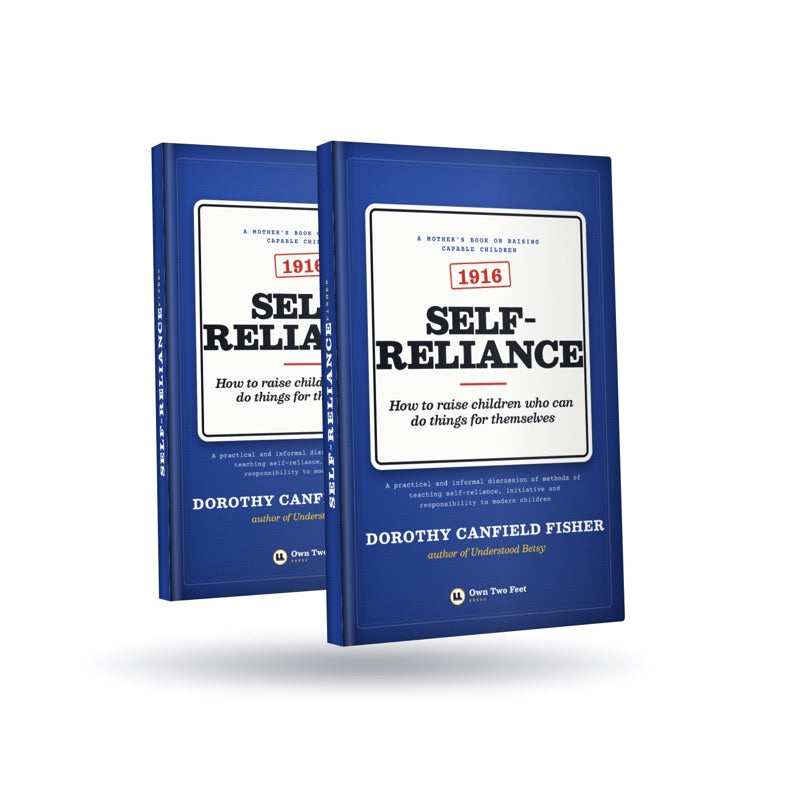
So the Family Set is two paperbacks and the ebook: one for each adult who runs the house. His father. His grandmother. The other household. Or the friend who complains about the same thing.
The exchange
Everything in your order
- Self-Reliance, complete and unabridgedAll 17 chapters, newly typeset and proofread. Ebook (PDF and EPUB) by email in minutes. Paperback printed to order in the USA, mailed with tracking to US addresses: about two weeks door to door.
- The Standing Jobs ChartDigital, printable. Real jobs by age, drawn from her chapters.included
- The First WeekDigital. Our short guide to handing over the first standing job. Written by us, not by Fisher.included
Ebook $19. Paperback + Ebook $37, free US shipping. Family Set, 2 paperbacks and the ebook, $57, free US shipping (two paperbacks would be $74). One-time purchase. No subscription.
The ebook is for tonight, on your phone, and can be bought from anywhere. The paperback is for the kitchen table: the one that gets written in and handed to the other adult.
The 1916 text is in the public domain in the United States. You are paying for a clean edition and the two guides, not for the words. $37, against a job you have worked unpaid for eleven years.
Send me the book
60 days, money back, keep the book. One-time purchase. No subscription.
The One-Job Guarantee
Read it. Hand over one standing job. If your house is no different, email us within 60 days and we refund what you paid. There is nothing to send back: the paperback, the ebook and the guides stay yours.
You do not need to explain. We do not promise it by a date, and neither did she.
60 days, money back, keep the book. One-time purchase. No subscription.
You can stop here and keep the idea for nothing. He isn't lazy. He's unemployed. Pick one thing your house needs tonight and tell him it is his.
What you will not have is the rest: which job at which age, what to say when he asks why, what never to do when he begs for money.
In the old home she describes, children worked “companionably side by side with the father and mother” (p. 150). You stop being the reminder. You get to be the person next to him.
He is eleven for 365 days.
Choose your edition. Tomorrow at 7:40, let one thing in that kitchen wait for him. Then stand in the doorway with your coffee and do the hardest job in the house: nothing.
Own Two Feet Press
Publishers of this edition
P.S. The promise: the jobs are his, and he does them because they are his. The terms: 60 days, money back, keep the book.
P.P.S. He will not end this arrangement himself. He likes the service, and he is right to. The service is excellent.
P.P.P.S. From page 24: “No child is naturally passive.” The Button taught him to wait. A standing job teaches him to start.
60 days, money back, keep the book. One-time purchase. No subscription.