Before you remind your son again
He isn’t lazy.
He’s unemployed.
6 things a mother knew in 1916
Every job in your house is yours, so all he practices is being served. She wrote down how to hand the work back, so you can stop being the reminder.

7:40 a.m. The bus comes at 7:52. Your eleven-year-old is on the stairs, one shoe on. You have said “shoes” three times.
Since 6:30 you have packed his lunch, fed the dog he begged for, signed the form, found the library book and pulled his jersey out of the dryer.
Five jobs. Every one of them yours. Now count his.
In 1916 Dorothy Canfield Fisher, a novelist and the mother of two small children, explained mornings like this one from her home in Vermont. She did not blame the boy. She showed where his work had gone.
-
1. Nobody fired him.
The work left the house.You asked nicely. You counted to three. You said it again, louder. That was not weak mothering, and he is not a bad kid.
In the old home, she wrote, “There were jobs suited to the capacity of children of every age” (p. 150). Then the dishwasher took the dishes, the dryer took the clothesline, and the app took the errand.
Call it the Button. It was in your house before he was. The Button did not make him lazy. It took his work.
The scan is page 3 of her book, as printed in 1916. The highlighter is ours, and so is the word unemployed. The diagnosis is hers.
so often in modern America one may press a button and be served
Dorothy Canfield Fisher, 1916p. 3 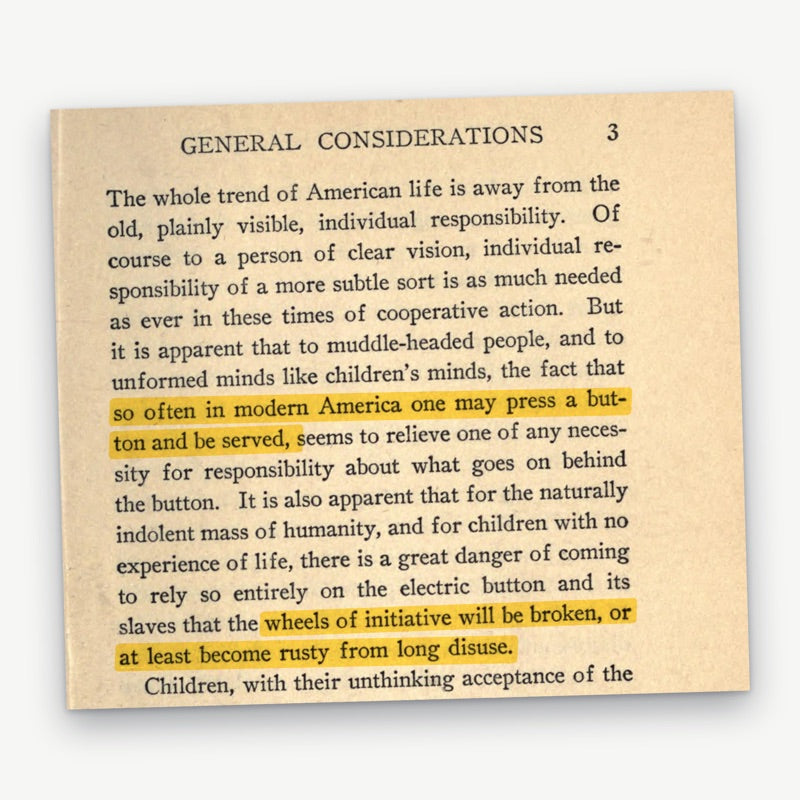
-
2. The better you run the house, the less he does.
Dinner appears. Clean shirts appear. He eats, gets up, and the plate stays where plates stay in a restaurant.
He isn’t ungrateful. A guest does not thank the hotel for hot water. He never sees it arrive. She put his side of it on page 28: “all the consequences of his acts are noiselessly and competently shouldered by other people.” You are the other people.
In 1916 the button rang for a servant. In your house it rings for you.
She had seen where it ends: young people “old enough to go away to college” still sure that clean clothes “grow of themselves in their bureau drawers” (p. 44).

The avowed aim of every good housekeeper is to run her house with no show of the effort it costs her, so smoothly that the machinery is both inaudible and invisible.
Dorothy Canfield Fisher, 1916p. 28 -
3. A sudden errand starts a fight.
A standing job doesn’t.“Can you just take these up?” “In a minute.” It is the fourth thing you have sprung on him since four o’clock. Not one of them was his job at 3:59.
She had a verb for that: pounced upon. You would hate it too. Picture a job with no description, where someone taps your shoulder all day with whatever just occurred to them.
A standing job is the opposite: his, the same every day, agreed sitting down. And when it is done, she wrote, “his time is, for the most part, his own” (p. 33).
You stop asking for help. You start handing over work.

children, even little children, are much like the rest of us and infinitely prefer to have some regular definite task, reasonably related to their own life, than to be pounced upon spasmodically at any hour which suits an adult
Dorothy Canfield Fisher, 1916p. 33 Show me the bookEbook or paperback · from $19
-
4. A reminder is proof the job is still yours.
The sticker chart worked, for a while. You were inspector and paymaster. The app reminds him. That is still a reminder. You changed the ringtone.
Taking the tablet works tonight. Tomorrow you are the warden, and wardens keep longer hours than mothers.
Run each fix past one sentence of hers (p. 55). Does it still happen when you leave the room? If not, you still hold the job. You are not reminding him of his work. You are doing the remembering, which is the work.
So the last step is the hardest. You stand in the doorway with your coffee and say nothing.

Nothing is enough which depends upon our presence, upon the presence of any adult.
Dorothy Canfield Fisher, 1916p. 55 -
5. He isn’t lazy.
The instinct is only asleep.He taught himself every game he owns. Nobody reminded him.
Her book has a college boy in it, “apparently invincibly lazy.” What changes him is not a lecture. It is the day “the responsibility for his own life is laid upon him” (p. 41).
She had a name for what is waiting in your son: the Robinson Crusoe instinct, the urge to manage for himself with his own hands (p. 70).
Asleep is our word. Asleep is not gone.

In a child it is almost always already present, already longing for exercise.
Dorothy Canfield Fisher, 1916p. 70 -
6. The first week tests you.
Picture a Tuesday like this.He will do it late, and badly. Wednesday he forgets, and you stand in the kitchen holding the dog’s scoop, with every instinct you own telling you to do it yourself.
Hand him the scoop. The dog eats late. The dog eats.
She never called this easy, and she warned that a capable child is not a quiet one (p. 5). She knew the arithmetic nobody can do at 7:40: his slow hour beats your thirty seconds.
Some ordinary Tuesday, you are on the porch with your feet up. Behind you the table is being set, and nobody asked. You are his mother again. Not his staff.

it is better for the little child to take an hour to put on his own shoes than for his mother to whisk them on for him in thirty seconds
Dorothy Canfield Fisher, 1916p. 18 Show me the bookEbook or paperback · from $19
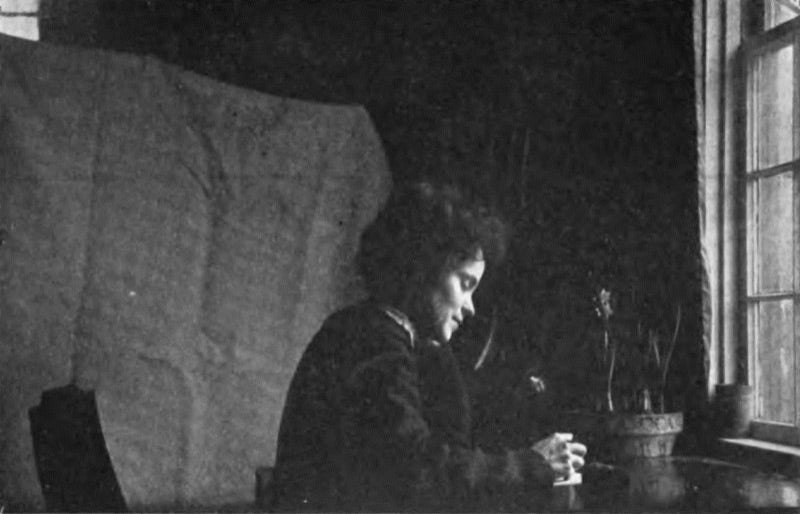
Notices of her book, 1916
The papers repeated her warning

Mrs. Fisher finds the present ‘push-button’ age unwholesome for children.
in this push-the-button age children lack the old occasions to do for themselves
An excellent book for parents who wish to cultivate in the child the independence of action and sense of responsibility that modern home life affords little opportunity to develop.
All her lines above come from one book: Self-Reliance.
The list is what she knew. The book is what to do about it: his own laundry bag at five (p. 44), the restaurant bill he checks and pays at ten (pp. 52–53), the family trip he plans at fourteen (p. 51).
The prose is 1916.
The children are yours.
Twelve chapters on the home, four on schools, a postscript. One adult who still does it for him undoes the job, so every adult in the house needs the same pages.
The new edition
Self-Reliance, and everything in your order
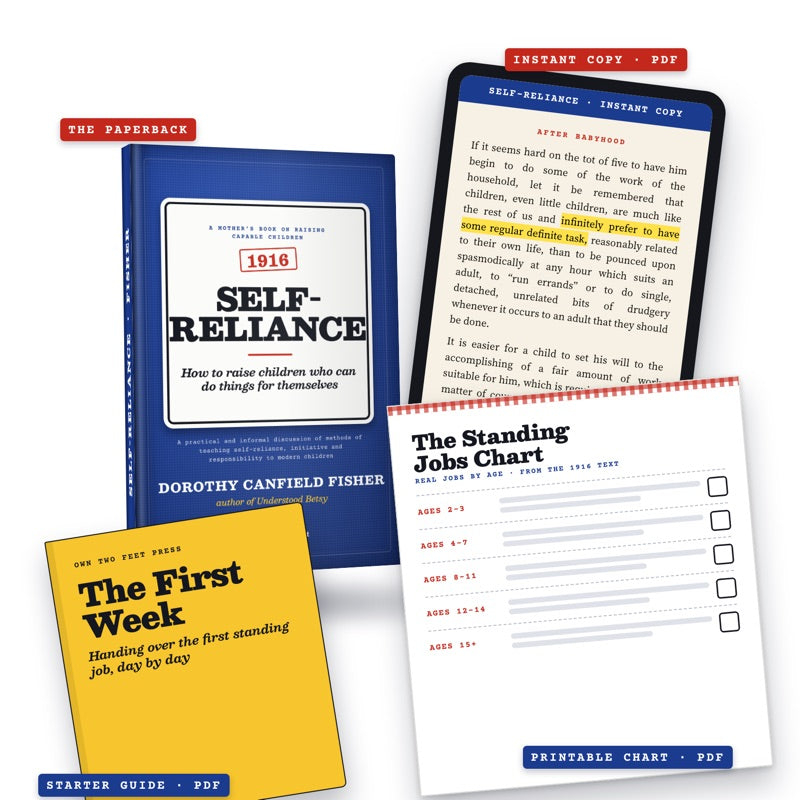
- Self-Reliance, complete and unabridgedAll 17 chapters, newly typeset and proofread.
- The ebookPDF and EPUB, in your inbox within minutes, with every edition.included
- The paperbackIf you choose it: printed to order in the USA, mailed with tracking, about two weeks door to door. US addresses.
- The Standing Jobs ChartPrintable. Real jobs by age, drawn from her chapters.included
- The First WeekOur short guide to handing over the first standing job. Ours, not Fisher’s.included
The 1916 text is in the public domain in the US, and its pages survive as scans. You are paying for a clean, newly typeset edition and the two guides, not for the words.
Self-RelianceDorothy Canfield Fisher · 1916
60 days, money back, keep the book.
One-time purchase. No subscription.
Paperback orders placed by December 2 are expected before Christmas by standard mail.
- 60-day money back
- Two guides included
- US-printed paperback
The One-Job Guarantee
Read it. Hand over one standing job. If your house is no different, email us within 60 days and we refund what you paid. You do not need to send anything back, and you do not need to explain.
The paperback, the ebook and both guides stay yours. We do not promise it by a date, and neither did she.
P.S. He will not end this arrangement himself. He likes the service, and he is right to. The service is excellent.
P.P.S. He is eleven for 365 days. Get the book tonight. Tomorrow at 7:40, let one thing in that kitchen wait for him.
Own Two Feet Press
Publishers of this edition
From $19. 60 days, money back, keep the book.
One-time purchase. No subscription.